What Does GVWR Mean in Vehicles?
If you have ever asked what is gvwr mean in vehicles, you are not alone. Many drivers see this term on a truck door sticker, then wonder what it really means. In simple words, GVWR tells you the maximum safe weight a vehicle can carry. That includes the vehicle itself, passengers, cargo, fuel, and anything you tow that places weight on the vehicle. Because of that, GVWR is one of the most important numbers you should know before you load a truck, SUV, or van.
GVWR stands for Gross Vehicle Weight Rating. However, the term can feel confusing at first. That is because it is not the same as the vehicle’s actual weight, and it is not the same as how much the vehicle can tow either. Instead, it is a limit set by the manufacturer. In other words, it is the highest total weight the vehicle should handle safely when fully loaded. Therefore, understanding this number helps you avoid overload, reduce wear, and drive with more confidence. Also, it can help you stay within legal limits in many places.
In 2026, more drivers are comparing trucks, trailers, and payload numbers than ever before. For that reason, learning what does GVWR mean can save you time and money. It also helps you choose the right vehicle for work, travel, or family use. So, before you buy, tow, or load your vehicle, you should know where GVWR fits into the bigger picture of weight ratings.
Meaning: The Basic Definition You Need to Know
GVWR means Gross Vehicle Weight Rating. That is the maximum allowable weight of a vehicle when it is fully loaded. This number comes from the manufacturer, and it usually appears on a label inside the driver’s door frame. Sometimes, it also appears in the owner’s manual. Because it is a rating, not a measurement, you should think of it as a safety boundary.
Here is what GVWR includes:
- The vehicle’s own weight
- All passengers
- Fuel
- Cargo in the cabin or bed
- Accessories and added equipment
- Tongue weight from a trailer, if applicable
This is why GVWR matters so much. A truck may look strong, but it still has a hard limit. If you go over that limit, handling can suffer. Braking can take longer. Tires may wear faster. Suspension parts may also experience more stress. As a result, overloading can create safety risks.
GVWR vs Curb Weight Explained
To understand gvwr vs curb weight explained, you need to compare a limit with a starting point. Curb weight is the weight of the vehicle with standard equipment and fluids, but without passengers or cargo. In contrast, GVWR is the maximum weight the vehicle can safely carry. So, curb weight is what the vehicle weighs before you add people and items. GVWR is the ceiling.
For example, imagine a pickup truck with a curb weight of 5,200 pounds. If that truck has a GVWR of 7,000 pounds, then it can carry up to 1,800 pounds of added weight, including people, cargo, and other load items. That extra amount is not always equal to payload capacity in a simple way, because other components and configuration details can affect the final number. Still, this example shows the basic relationship.
This difference matters for several reasons:
- Curb weight helps you understand the vehicle’s base mass
- GVWR helps you understand the safety limit
- The gap between the two helps estimate payload
- Proper comparison helps you avoid overload
- It helps you choose the right vehicle for your needs

Difference Between GVWR and Payload Capacity
The difference between GVWR and payload capacity is one of the most useful things to understand. GVWR is the maximum total weight the vehicle can handle. Payload capacity is the maximum weight you can add to the vehicle without exceeding that GVWR. In other words, payload is part of the GVWR equation.
Here is the simple formula:
- Payload capacity = GVWR – curb weight
That formula gives you a starting point. However, you should also subtract any added accessories or equipment already installed. That is because those items count toward the total weight. If you have a truck topper, a steel bumper, or a heavy rack, your usable payload goes down.
Let’s look at a practical example:
- GVWR: 7,000 pounds
- Curb weight: 5,200 pounds
- Basic payload estimate: 1,800 pounds
- Added equipment: 200 pounds
- Realistic remaining payload: 1,600 pounds
That means the truck can carry people, gear, and cargo up to the remaining payload limit. If you add more than that, you move closer to or beyond the vehicle’s rated maximum. At that point, safety and performance can decline.
Why GVWR Is Important for Towing
Many drivers search why gvwr is important for towing because towing changes weight in a big way. When you tow a trailer, not all the trailer’s weight stays behind the vehicle. A portion of that weight presses down on the hitch. That downward force is called tongue weight. Tongue weight counts against the vehicle’s total load. So, towing affects GVWR directly.
Here are key reasons GVWR matters for towing:
- It helps protect the suspension
- It helps maintain braking performance
- It supports better steering control
- It reduces tire stress
- It helps prevent sway and instability
How to Calculate GVWR
Many readers want to know how to calculate gvwr. The good news is that you usually do not need to calculate the manufacturer’s GVWR itself, because the manufacturer already sets it. However, you do need to calculate your vehicle’s current loaded weight and compare it to GVWR. That process helps you know whether you are safe.
Use this process:
- Find the GVWR on the door label or in the manual
- Find the curb weight of the exact vehicle configuration
- Add the weight of passengers
- Add fuel weight
- Add cargo and tools
- Add aftermarket equipment
- Add trailer tongue weight, if towing
Then compare the total to the GVWR. If your total weight is below the limit, you are within rating. If it is at or above the limit, you need to reduce load.
A practical example:
- GVWR: 7,200 pounds
- Curb weight: 5,300 pounds
- Driver and passenger: 350 pounds
- Cargo: 400 pounds
- Fuel: 150 pounds
- Tongue weight: 600 pounds
- Total: 6,800 pounds
How to Read GVWR on a Truck or SUV
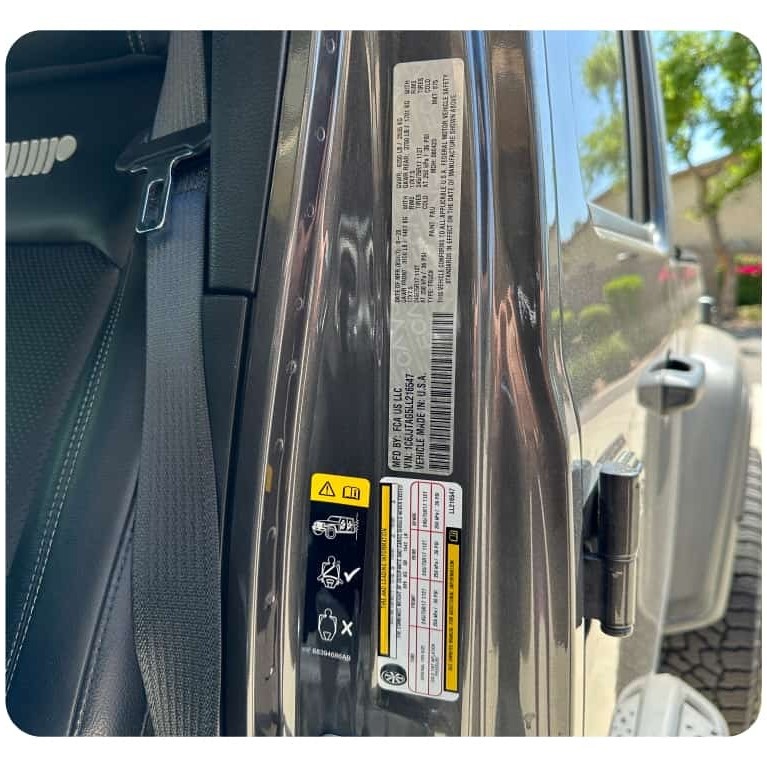
If you want to know how to spot GVWR in real life, start with the driver’s door jamb. Most vehicles have a certification label there. In some cases, the information may also be in the manual or on a label near the frame.
When you read the label, look for:
- GVWR
- Front axle rating
- Rear axle rating
- Tire information
- Load limits
These details work together. GVWR tells you the total limit, while axle ratings show how much each axle can support. That means you should not only think about total weight. You should also think about how weight is distributed. For example, too much gear in the bed can overload the rear axle even if the truck stays under GVWR. Therefore, balance matters as much as total weight.
Also, tire ratings are important. Tires must support the load too. If you load a truck near its limit but use tires with weak load ratings, you create another risk. That is why professionals check all weight-related labels, not just one number.
Common Examples by Vehicle Type
GVWR values vary widely. A small SUV may have a much lower rating than a heavy-duty truck. Meanwhile, a cargo van or commercial truck may have a very high rating. That is why context matters. The same term can mean very different things depending on the vehicle.
Typical ranges can look like this:
- Compact SUV: lower, often suited for light family loads
- Mid-size pickup: moderate, good for daily use and light towing
- Full-size half-ton truck: higher, useful for work and trailers
- Three-quarter-ton truck: stronger, often used for heavier cargo
- One-ton truck: very high, common in commercial and heavy-duty use
However, these are general examples only. The exact number depends on engine, cab style, bed length, drivetrain, suspension, and factory package. Therefore, you should never guess based on vehicle class alone.
Here is why those differences matter. A family SUV may carry five or seven people, plus luggage, but it can still reach its limit quickly. A pickup with a larger GVWR may handle more payload, yet towing a trailer still consumes part of that allowance. So, every vehicle needs a close look at the actual label.
Safety, Legal, and Maintenance
Staying under GVWR helps in more ways than many drivers realize. First, it improves safety. A vehicle that is too heavy may brake slower and handle poorly. It may also feel unstable in turns or during emergency maneuvers. Therefore, respecting the rating helps protect everyone in the vehicle and on the road.
Second, it can help you stay compliant with the law. In some areas, commercial and private vehicles can face fines if they exceed weight limits. Even when enforcement is not immediate, overloading can create issues after an accident. So, proper weight control is not just a technical detail. It is also a legal and financial concern.
Third, it supports better maintenance. Overloaded vehicles wear out faster. Tires run hotter. Brakes work harder. Shocks, springs, and wheel bearings also experience more stress. As a result, the vehicle may need repairs sooner. In the long run, staying within ratings can save money.
Here are some practical habits:
- Weigh the vehicle before long trips
- Remove unnecessary cargo
- Distribute load evenly
- Check tire pressure before towing or hauling
- Review payload after adding accessories
- Recheck weight after seasonal changes
FAQ
What’s the difference between GVWR and weight?
GVWR is the maximum allowed weight rating. Weight is the actual measured mass of the vehicle or load. So, GVWR is a limit, while weight is the current condition. In practice, you compare your actual weight to the GVWR to see if you are safe.
What does 7000 lb GVWR mean?
A 7000 lb GVWR means the vehicle should never exceed 7,000 pounds when fully loaded. That total includes the vehicle, passengers, cargo, fuel, accessories, and any tongue weight from a trailer. If the actual total goes over 7,000 pounds, the vehicle is overloaded.
What does 10,000 GVWR mean on a truck?
A 10,000 GVWR on a truck means the truck’s maximum allowed loaded weight is 10,000 pounds. This rating is common in heavier pickup and commercial-style vehicles. It does not mean the truck can tow 10,000 pounds. Instead, it means the truck itself, with everything inside or on it, should stay under that weight.
What does 6500 GVWR mean?
A 6500 GVWR means the vehicle’s maximum total loaded weight is 6,500 pounds. That total includes passengers, cargo, fuel, and any load carried by the vehicle. To stay safe, you should keep the actual weight below that number at all times.
What does GVWR mean in vehicles?
In vehicles, GVWR means Gross Vehicle Weight Rating. It is the maximum weight the vehicle is designed to carry safely. It helps drivers understand load limits, towing impacts, and payload boundaries.
Final Takeaway
Now you know what is gvwr mean and why it matters in real driving. It is not just a technical label. It is a key safety number that affects hauling, towing, handling, braking, and long-term vehicle health. If you understand what is gvwr mean in vehicles, you can make better loading choices, avoid overload, and protect your truck, SUV, or van. So, before your next trip or job, check the label, compare the numbers, and load with confidence.
Leave a Reply